Start with the numbers for your street
Temple City is served by more than one water system, and hardness is different in each. Golden State Water's South San Gabriel system reported 2025 hardness from 189 to 310 mg/L, an average of about 240 mg/L or 14 grains per gallon. Its South Arcadia system averaged 160 mg/L, about 9.4 grains. The Cal Am San Marino system, which reaches parts of the city, reported 162 mg/L, about 9.5 grains, in its 2023 report.
Those are utility averages and not a test of your tap. Your water bill names your utility, and the utility's annual water quality report lists hardness. A hardness test kit or a lab test tells you what comes out of your faucet.
What hard water does inside a house
- White crust on faucets, shower heads and glass, and spots on dishes.
- Scale on heating elements and a rumbling water heater tank.
- Reduced flow as scale narrows pipe and aerators.
- Soap that does not lather well and leaves a film.
A water heater is where the cost shows up, because scale lowers efficiency and shortens life. The effects on a tank are covered on our water heater repair page, and tankless heaters are even more sensitive, as explained under tankless water heater.
According to the federal Safe Drinking Water Act, water utilities publish an annual water quality report, called a Consumer Confidence Report. Read yours before you choose a system.
Softener, filter, scale inhibitor or reverse osmosis
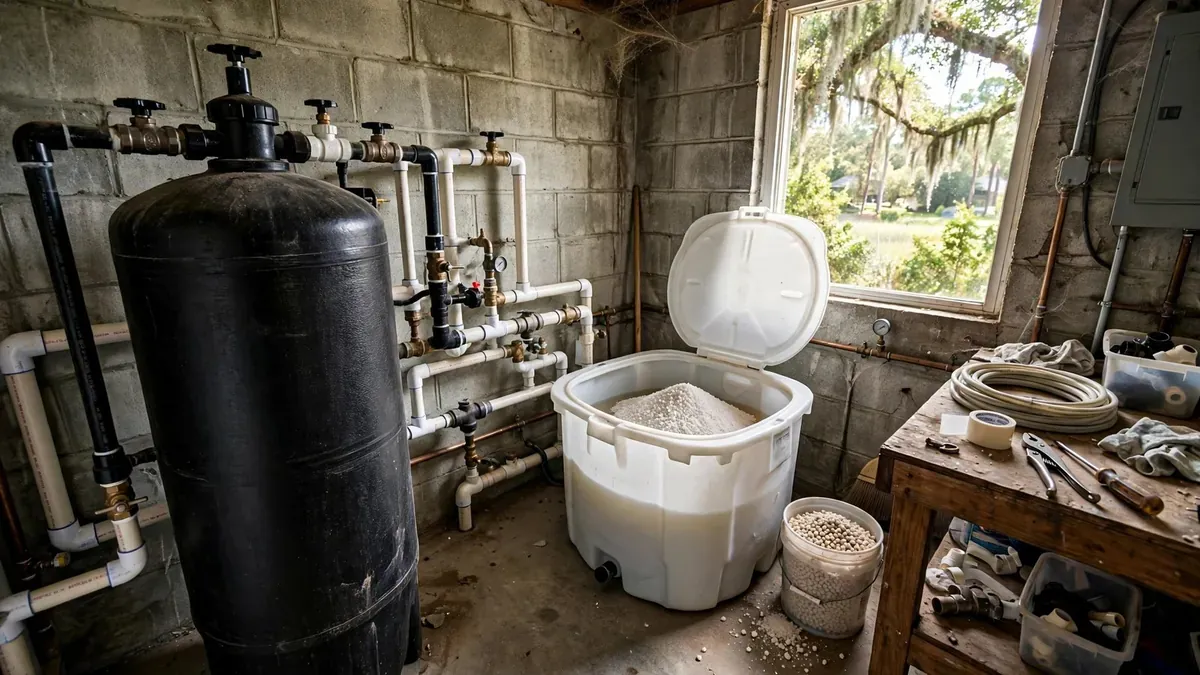
These systems do different jobs and are often confused. A salt-based softener swaps calcium and magnesium for sodium and stops scale. A whole-house carbon filter improves taste and removes chlorine but does not soften. A scale inhibitor changes how minerals form and leaves the water's minerals in place. A reverse osmosis unit at the kitchen sink produces drinking water by forcing it through a membrane.
| System | What it does | What it does not do |
|---|---|---|
| Salt softener | Removes hardness, stops scale | Does not filter chlorine or contaminants |
| Whole-house carbon filter | Reduces chlorine, taste and odor | Does not remove hardness |
| Scale inhibitor | Reduces scale buildup without salt | Does not make water soft |
| Reverse osmosis at the sink | Treats drinking and cooking water | Does not treat the whole house |
Scale on everything?
Call (626) 898-6169. We will talk through test results and treatment options for your house.
Honest limits and local rules
A softener adds sodium and uses water and salt to regenerate. Some communities restrict the discharge of brine into sewers, and the rules vary. Before you install one, ask your water utility and the city whether any local rules apply, and ask your doctor if you are on a low-sodium diet.
We do not make health claims about water. If you are worried about contaminants, read your utility's report, ask a lab for a test, and choose treatment based on what is actually in the water. We can install and connect equipment once you have chosen it.
Which Temple City households benefit most
Houses on the harder South San Gabriel supply gain most from treatment. A house with a tank heater, a dishwasher and glass shower doors sees the effect quickly, and a household planning a tankless heater should treat the water or plan annual flushing.
Because 88.1 percent of Temple City's housing is single-family, most households own the plumbing and can choose treatment. If you rent, ask your landlord before changing anything.
The install itself needs a place for the unit, a drain for the regeneration water, an electrical outlet and a bypass. Older houses from the 1950s, which are 30.6 percent of the city, may have tight garages and galvanized pipe that is not ready to take a new unit. In that case a repiping assessment comes first.
What decides the price of water treatment
Want your real number? Call (626) 898-6169 and tell us what you want to fix. The plumber states the price before work starts.
Questions we get asked
It depends on the system that serves your address. Golden State Water's South San Gabriel system averaged about 240 mg/L in 2025 and its South Arcadia system about 160 mg/L. Your utility's annual report shows its figures.
Not every house does. If you see scale, spots and a noisy water heater, softening helps. If your priority is taste, a filter or sink-level reverse osmosis may be a better fit.
Softened water has added sodium. Ask your doctor if you are on a restricted diet, and consider a separate drinking tap.
Your water bill names the utility. Its annual water quality report lists hardness and other measurements.
It slows scale buildup, which helps heaters and tankless units. Annual maintenance is still a good idea.