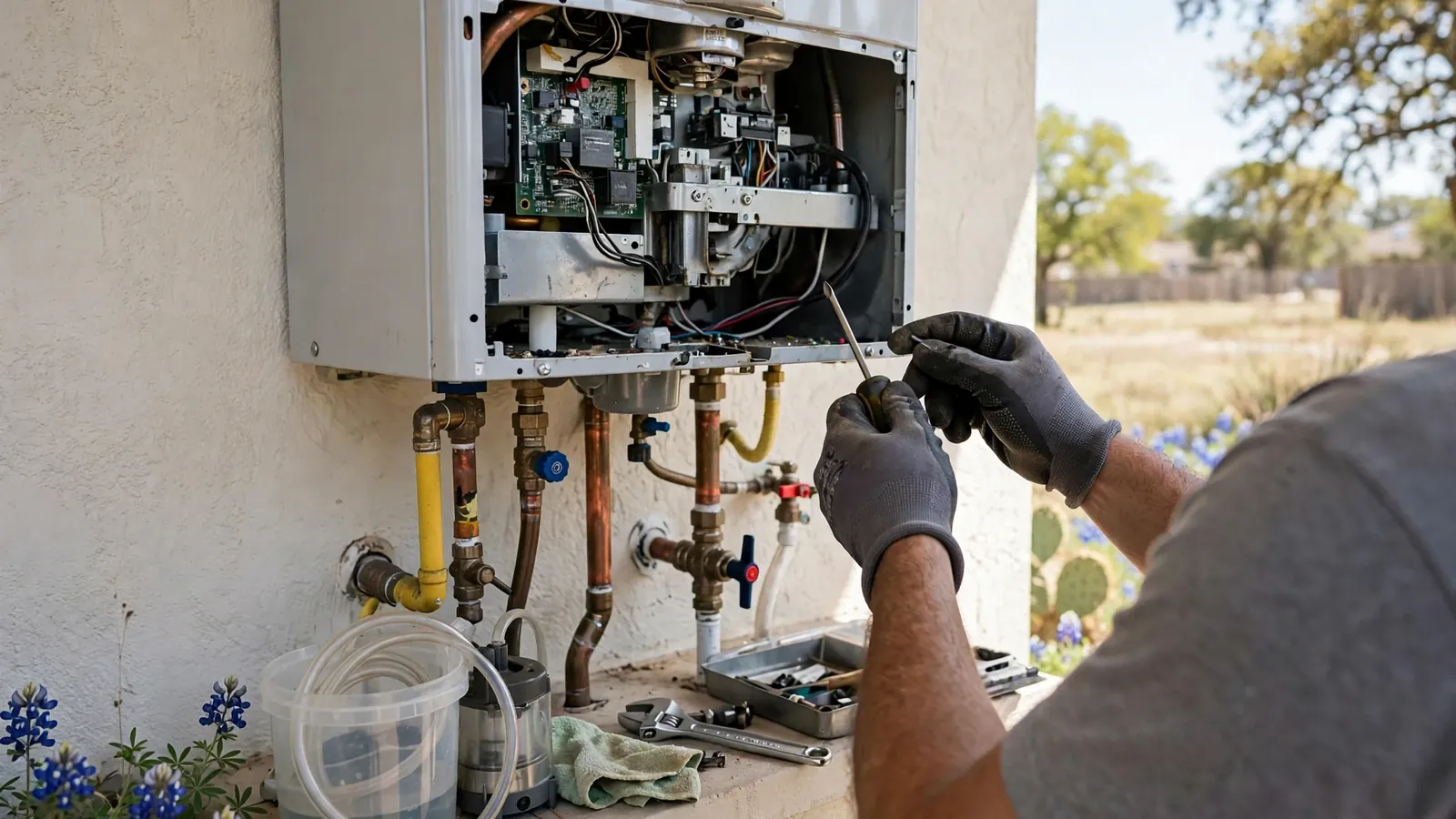
How a tankless water heater works
When a hot tap opens, flow through the unit triggers a burner or heating element that raises the water to the set temperature as it passes through a heat exchanger. There is no stored tank to heat all day, and the supply is continuous as long as the demand stays within the unit's flow rating.
That makes sizing a matter of flow, not volume. A unit that serves one shower at a time may struggle when two showers and a dishwasher run together. We add up the fixtures you use at once and choose a unit that meets them.
What a tankless install requires
| Item | Gas tankless | Electric tankless |
|---|---|---|
| Fuel supply | Larger gas line, often 3/4 inch | High amp circuit, sometimes a panel upgrade |
| Venting | Stainless or approved vent, outside termination | None |
| Water | Isolation valves for flushing | Isolation valves for flushing |
| Condensate | Drain for condensing models | None |
| Space | Wall mount with clearances | Small wall mount, near the point of use |
A 120 volt tankless unit exists, but it is small and suits a single sink or a point-of-use location. It cannot serve a whole house.
Venting and gas line sizing for a tankless heater follow the California Plumbing Code, which is based on the Uniform Plumbing Code (UPC), plus the manufacturer's installation guidelines. The same guidelines set the descaling interval, which matters with hard water.
Flushing and descaling, the part people forget
Minerals in the water leave scale inside the heat exchanger, and a tankless unit has narrow passages that clog more easily than a tank bottom does. Scale reduces flow, raises the temperature the burner has to reach and eventually triggers error codes.
A flush circulates a descaling solution through the unit and then rinses it. Many manufacturers call for a yearly flush in hard water areas, so check your manual. If you have never flushed yours, now is the time. Install isolation valves on the unit so the flush is a short visit.
Tankless install, repair or flush?
Call (626) 898-6169. We check the gas, vent and water before we recommend anything.
Repair signs to watch
- A cold sandwich effect, with hot water that turns cold and hot again.
- Error codes on the display that return after a reset.
- Reduced flow at the tap even though the rest of the house is fine.
- Rumbling or popping from inside the unit.
- Water that takes longer to reach the tap than it used to.
Many of these are scale, a clogged filter screen or a failing sensor. If the unit is past its useful life, a tank may be a smarter swap, as explained under water heater replacement.
Hard water makes tankless service a Temple City question
Golden State Water's South San Gabriel system reported hardness from 189 to 310 mg/L in 2025, with an average of about 240 mg/L, or 14 grains per gallon. That is firmly in the range where descaling matters. The South Arcadia system averaged 160 mg/L, roughly 9.4 grains.
Which system serves your street decides how fast scale grows, and the answer is on your water bill. If you are choosing a tankless unit, we recommend isolation valves from day one and a plan for annual flushing. A softener or scale inhibitor is also worth considering, and our water softener and filtration page explains the trade-offs.
Older Temple City houses often have a gas line sized for a tank heater. We measure the load and tell you honestly whether the line needs upgrading.
What decides the price of tankless work
Want your real number? Call (626) 898-6169 and tell us whether it is an install, a repair or a flush. The plumber states the price before work starts.
Questions we get asked
It depends on use. It gives continuous hot water and saves floor space, but costs more to install and needs yearly flushing in hard water. For a household that runs out of hot water on a tank, it can be a good fit.
Many manufacturers advise yearly in hard water. Check your manual. With the water in parts of Temple City, an annual flush is a reasonable habit.
It is not a simple swap. The gas line, venting and electrical supply often change, and code and warranty rules apply. A licensed plumber should do the install.
It suits a single sink or a point-of-use location, not a whole house. Larger units need 240 volts or gas.
The usual causes are low flow, scale or a sensor problem. A flush and a check of the filter screen often help.