Start with what you want to fix
Filtration is often sold as a single idea, but it is several. Some systems improve taste and smell. Some catch grit. Some soften water. Some remove dissolved substances from drinking water. The right choice begins with what you are trying to fix, and the most useful first step is to read the water quality report your utility publishes.
A system that solves the wrong problem is a waste of money. A carbon filter will not soften water. A softener will not remove chlorine. Knowing the difference saves you from buying the wrong box.
The main methods, one by one
| Method | How it works | Good for |
|---|---|---|
| Sediment filter | A porous cartridge traps particles | Grit, rust flakes and cloudy water |
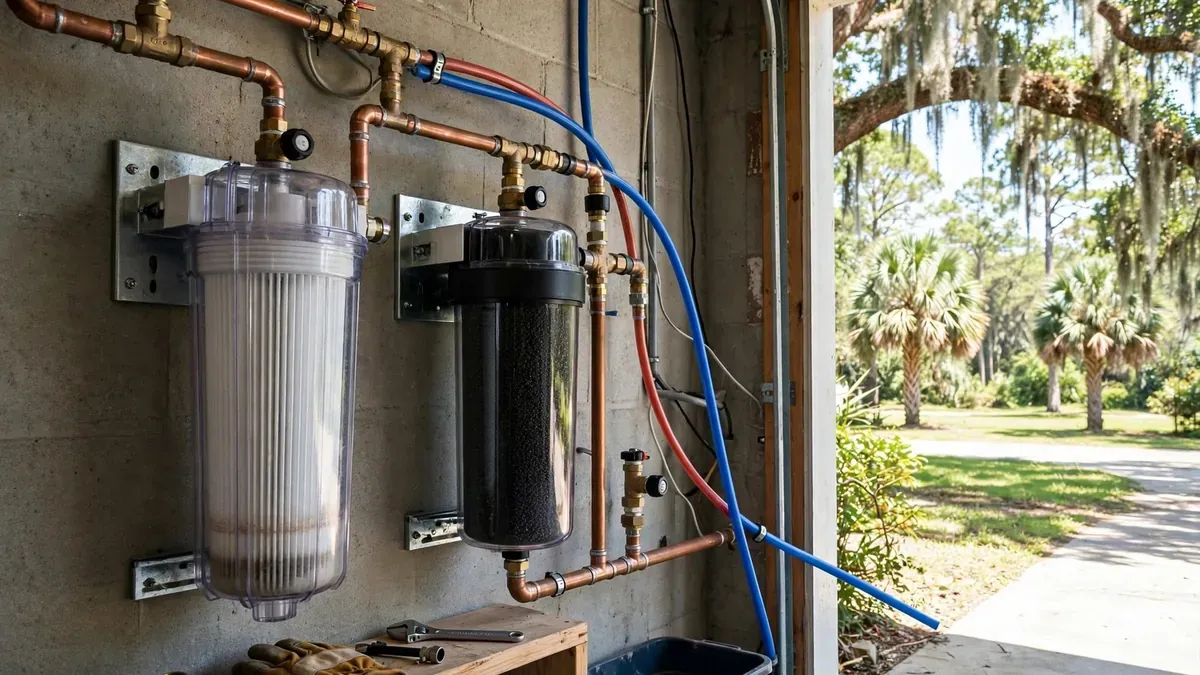
| Activated carbon | Carbon adsorbs chemicals as water passes | Chlorine taste and odor, some organic compounds |
| Ion exchange softener | Resin beads swap calcium and magnesium for sodium | Hardness, scale |
| Reverse osmosis | Pressure pushes water through a membrane | Drinking water at one tap |
| Ultraviolet light | UV exposure inactivates microbes | Microbial control on private supplies |
Many homes combine two of these, such as a sediment and carbon filter at the main and a reverse osmosis unit at the kitchen sink.
Safety guidance before you buy: if a test shows lead or another contaminant, what to do first is read your utility's water quality report and ask a qualified professional, not rely on a filter alone.
Reading the labels
Look for certification marks from independent bodies. NSF/ANSI Standard 42 covers aesthetic effects such as taste and chlorine. NSF/ANSI Standard 53 covers health-related contaminants. NSF/ANSI Standard 58 covers reverse osmosis systems. A product that cites a standard and lists what it was tested for is more informative than one that makes broad claims.
We do not make health claims about water. If you are worried about a specific contaminant, a lab test of your own tap is the right step, and the choice of treatment follows from what the test shows.
Choosing a water system?
Call (626) 898-6169 to talk it through.
How a softener works
Inside a softener is a tank of small resin beads that hold sodium ions. As hard water passes through, the beads trap the calcium and magnesium that cause scale, and release sodium. When the beads are full, the system flushes itself with a salt brine and sends the waste to a drain.
That is why softeners need a drain, power and a supply of salt. They protect heaters and fixtures from scale. They also add sodium to the water and use water to regenerate. We cover the decision in more detail on our water softener and filtration page.
Temple City tap water in numbers
Temple City is served by more than one water system. Golden State Water's South San Gabriel system reported 2025 hardness from 189 to 310 mg/L, an average of about 240 mg/L or 14 grains per gallon. Its South Arcadia system averaged 160 mg/L, about 9.4 grains. The Cal Am San Marino system, which reaches parts of the city, reported 162 mg/L in its 2023 report.
Those figures are utility averages. Your address may be on a different system, and a test of your own tap is the real answer. Utilities publish an annual consumer confidence report, and it is the best source for what is in the water before it reaches your house.
Neighbors in San Marino and Arcadia have their own utilities and their own reports, which is why a recommendation for one house does not always fit another.
Matching the system to the problem
- Scale on faucets and a noisy water heater point to hardness, so a softener or a scale inhibitor is the fit.
- Chlorine taste or smell points to activated carbon.
- Cloudy water or grit points to a sediment filter.
- A desire for the cleanest drinking water at one tap points to reverse osmosis.
If a tankless heater is in your plans, hardness is a bigger issue, since scale builds in narrow passages. Our water heater installation page explains how treatment and heater choice fit together.
What keeps costing money after the install
The price of the equipment is only part of the cost. Softeners need salt, and a family can use a bag every month or two depending on hardness and water use. Carbon and sediment cartridges need replacing, often every few months to a year. Reverse osmosis membranes last longer, but the pre-filters ahead of them need changing.
A system that is neglected can do harm. A cartridge that has been in use for far too long can hold bacteria, and a softener with no salt does nothing. Set a reminder and keep a note of the model and replacement dates near the equipment.
Questions to ask an installer
Ask what problem the system is meant to solve and what test result supports that. Ask for the NSF/ANSI standard and the contaminants the equipment was tested for. Ask where the drain goes, how much water the system wastes and how often parts need replacing.
Ask what happens to the warranty if you do not follow the maintenance schedule. A good installer answers directly. If the answer is a sales pitch with no figures, take your time. Our plumbing installation page describes how we plan the plumbing around the equipment you choose.
Installing and maintaining a system
Most systems need a place to sit, a bypass so you can isolate them and a drain if they regenerate. Filters need cartridges replaced on a schedule, and reverse osmosis membranes wear out. A system with neglected cartridges can make water worse. Put the replacement dates on your calendar when it is installed.
If you want a plumber to plan and connect the equipment once you have chosen it, call (626) 898-6169.
Questions Temple City homeowners ask
Most do not. Carbon and sediment filters leave hardness in place. A softener or scale inhibitor addresses hardness.
Read your utility's water quality report and note what you want to fix, such as taste, scale or cloudy water.
It gives very clean drinking water at one tap, and it wastes some water and needs filter changes. It fits households that want that.
It varies by system, from an average of about 160 mg/L to about 240 mg/L in the Golden State Water systems that serve the city.
Yes. Cartridges and membranes wear out and need replacement on a schedule.
Not sure which filter fits your water?
Tell us what bothers you at the tap and we will explain the options that match. Call (626) 898-6169.