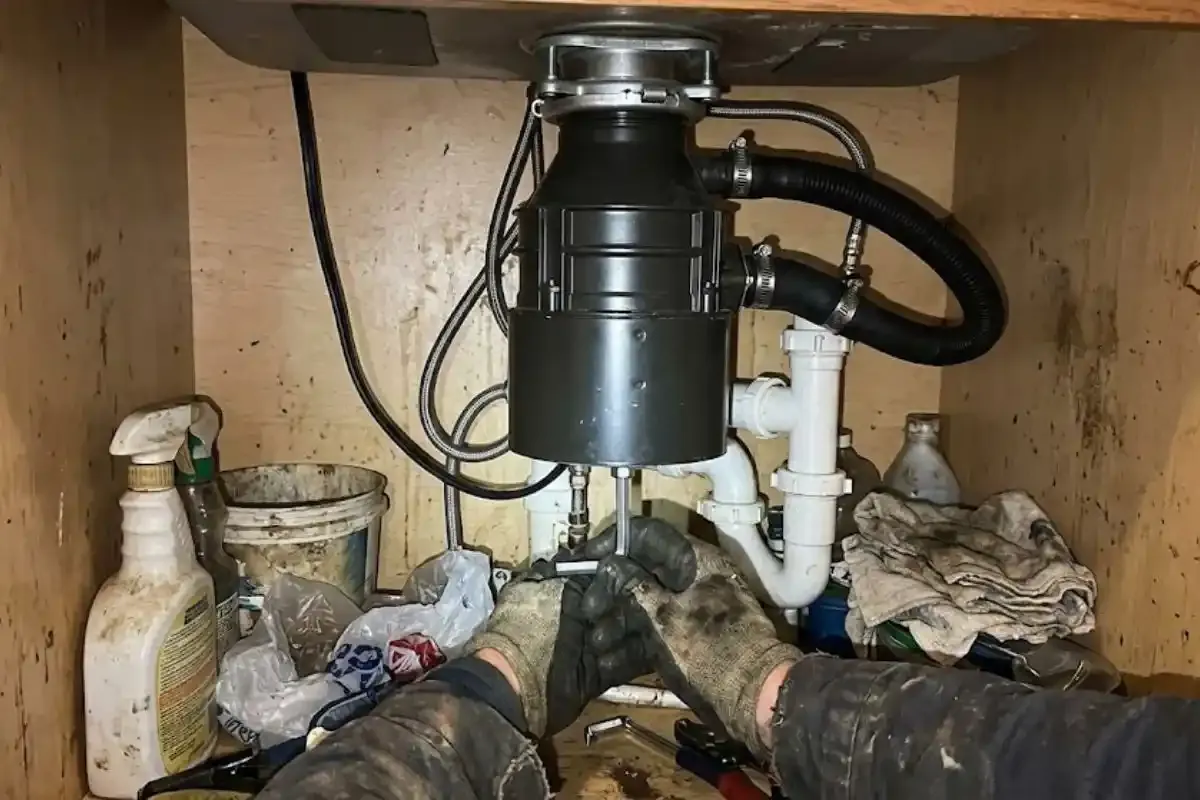
What a disposal connects to
A disposal sits under the sink and bolts to the sink drain opening. It has three connections to know about. The top connects to the sink flange, which is sealed with putty or a gasket. The side outlet connects to the drain trap and the waste line. A second small inlet on the side, if present, takes the dishwasher drain hose.
The unit also needs power, through a switch on the wall or an air switch on the counter, and an outlet or a hardwired connection under the sink. The plumbing and the wiring are separate jobs, and an electrician may do the wiring, depending on your house.
The dishwasher connection
A new disposal has a plug in the dishwasher inlet, and it must be knocked out with a hammer and screwdriver before the dishwasher hose is connected. Forgetting this step is the most common installation mistake, and the dishwasher then fills with water and will not drain.
The dishwasher drain hose also needs to rise to the underside of the countertop in a high loop, or run through an air gap, so that sink water cannot flow back into the dishwasher. Follow the dishwasher manual and local code, which can specify one or the other.
Under the California Plumbing Code, which is based on the Uniform Plumbing Code (UPC), the disposal needs a trap, and the dishwasher drain needs a high loop or air gap.
Drain size, the trap and slope
Kitchen drains are normally one and a half inches. A disposal sends a lot of food waste into that pipe, and the pipe has to carry it away. The trap must be below the disposal and connect to the wall with a gentle downward slope. Too little slope and food waste settles, too much and water outruns the solids.
| Problem | Cause | Fix |
|---|---|---|
| Dishwasher does not drain | Knockout plug left in | Remove the plug and clear the hose |
| Leak at the top | Flange not sealed well | Reseat the flange with fresh putty |
| Slow drain after install | Trap too low or wrong slope | Rework the trap and arm |
| Unit hums and trips | Wrong power setup | Check the switch and circuit |
| Smell from the sink | Food waste in the trap | Clean the trap, run cold water longer |
Planning a disposal?
Call (626) 898-6169 and we will check the drain.
Choosing a size
Disposals range from about a third of a horsepower to one horsepower or more. A larger motor chews faster and jams less, and it costs more. For a household that cooks often, a half horsepower or larger is a sensible choice, and a continuous-feed model is the usual type.
Another choice is how the disposal mounts. Some mount with a simple twist-lock, which makes replacement easier, and others use a fixed ring that takes more time to remove. If your old unit has leaked, check the cabinet floor and the shutoffs too. We cover that in our faucet and valve repair service, and the disposal itself is handled under garbage disposal repair.
Older kitchens in Temple City
Houses built in the 1950s make up 30.6 percent of Temple City's housing. Kitchen drains in those houses are often original or partly replaced, and they may have scale and grease on their walls. Adding a disposal sends more material down a pipe that may already be narrowed, so a camera look before you install one is cheap insurance.
Water hardness plays a role too. Golden State Water's South San Gabriel system averaged about 240 mg/L in 2025, and scale can build on seals and the grinding surfaces. Rinse with cold water while the unit runs, and clean the trap if the smell returns.
Temple City's municipal code adopts the 2025 California Plumbing Code, and permit rules vary by job, so ask the Temple City building department. If you live in the neighboring cities, our pages for El Monte and Rosemead describe the older housing stock there.
What to put in and what to keep out
A disposal is meant for soft food scraps. Keep out grease, bones, fibrous peels, large amounts of coffee grounds and anything that expands in water, such as rice and pasta. Never put a hand in the disposal, and never use chemical drain cleaners in it.
If the sink drains slowly even with the disposal clear, the problem is further down the line. Our drain cleaning page covers that.
Wiring and switch options
Disposals run on household power. Some come with a cord that plugs into a switched outlet under the sink. Others are hardwired into a junction box. The switch can be a wall switch, an air switch on the countertop or a switch built into the cabinet.
If your sink has a switch but no outlet under it, an electrician may need to add one. Do not modify wiring if you are not qualified. A disposal on a circuit shared with a dishwasher or other loads can trip the breaker, and a dedicated circuit is better.
Make sure power is off at the breaker before you work, because the switch alone does not isolate the circuit.
A first-day checklist after the install
- Run cold water into the sink and check every joint under the cabinet for drips.
- Run the dishwasher through a cycle and watch for water backing up into the sink.
- Switch the disposal on with water running and listen for rattles or scraping.
- Check the flange for a seal at the top, from inside the cabinet.
- Dry the cabinet floor and look again after an hour.
A small drip on day one is easier to fix than a rotted cabinet a year later. If anything looks off, call us before it gets worse.
When to call a plumber
Call if you are not sure about the wiring, if the cabinet shows water damage, if the old drain is corroded or if the sink drains slowly. We can install the unit, reconnect the dishwasher drain and test for leaks. Call (626) 898-6169 and tell us the brand and size you want.
Questions Temple City homeowners ask
It depends on the existing wiring. If there is a switched outlet under the sink, a plug-in unit may be all you need. Otherwise an electrician sets it up.
The knockout plug in the disposal's dishwasher inlet was probably left in. Remove it and clear the hose.
A half horsepower or larger suits most households that cook regularly. Bigger motors jam less.
It may. A camera look shows whether the drain is narrowed by scale or grease.
Permit rules vary. Ask the Temple City building department about your project.
Disposal install not draining right?
Explain how your sink and dishwasher connect and we will point to the likely snag. Call (626) 898-6169.